
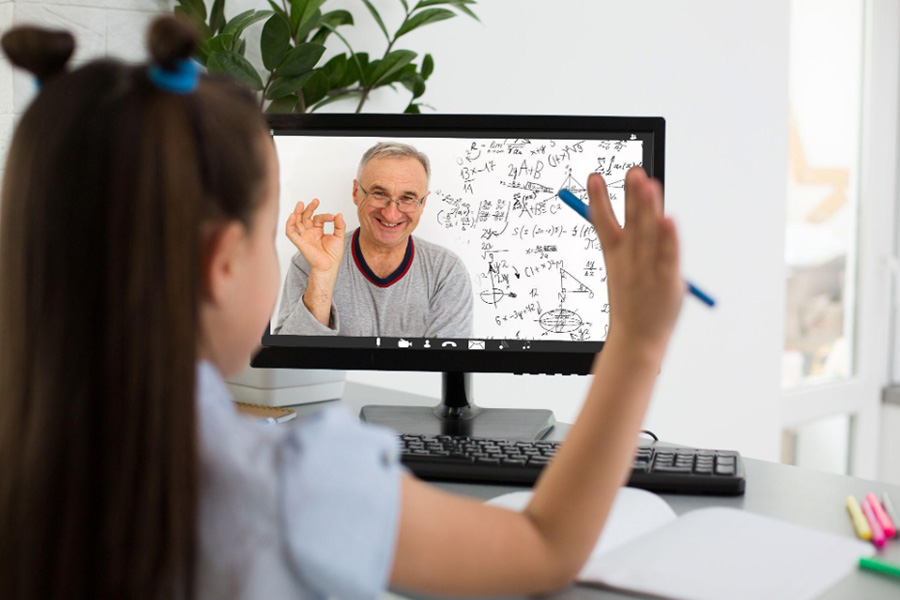
Math is the subject parents worry about most when online tutoring comes up. The reasoning feels solid enough on the surface; you need to see the working, step by step, to catch exactly where a student went wrong, and a screen supposedly gets in the way of that. In practice, the opposite is often true. A properly run online lesson can make a student’s working considerably easier to follow than watching it unfold on paper from across a table.
What a Shared Screen Actually Lets a Tutor See
Watching a student work through a problem in person means glancing over at a notebook, often at an angle, often after several steps have already passed by. A shared digital whiteboard puts every step directly in front of the tutor as it happens, at full size, with the ability to pause on any specific line and ask exactly what the student was thinking at that point. The physical distance disappears, and with it, a surprising amount of the guesswork about where a mistake actually crept in.
Why ‘You Can’t See the Working’ Misses What’s Actually Changed
The objection to online math tutoring assumes the format hasn’t evolved much beyond a phone call with a textbook nearby. Modern setups look nothing like that. Shared annotation tools let a tutor write directly on top of a student’s own working, circle the exact line where an error appears, and walk back through the reasoning together in real time, all without either party needing to angle a notebook toward a webcam and hope for the best.
Why This Matters Especially for E Math
E Math questions frequently reward method as much as the final answer, which means catching exactly where a student’s approach diverges from the correct one matters more here than in subjects with less emphasis on shown working. Careful E Math tuition in Singapore depends heavily on this kind of precise, step-by-step review, and a clear digital view of the working often makes that review considerably easier to do thoroughly.
A tutor who can zoom directly into a single problematic line, rather than squinting at handwriting across a table, tends to identify the actual point of confusion faster, not slower, than the in-person equivalent.
What a Good Online Setup Actually Enables
A handful of specific features tend to make the biggest difference in practice:
- Writing directly on top of a student’s own working to flag the exact step in question.
- Reviewing earlier steps instantly, without flipping back through pages of a physical notebook.
- Zooming into a single line of working for a closer, clearer look than eyesight alone typically allows.
- Saving a session’s annotated work for review later, something a physical notebook rarely offers as conveniently.
What Actually Separates a Good Online Tutor From a Weak One
The format itself isn’t the deciding factor; how well a tutor actually uses the available tools is. A genuinely capable online math tutor in Singapore treats the shared screen as an active teaching tool, not a passive video call running in the background, actively annotating, questioning, and reviewing work in real time rather than simply watching a student solve problems in silence.
Why This Assumption Persists Despite the Tools Improving
Online tutoring’s early reputation was shaped by whatever tools happened to be available at the time, often little more than a basic video call with no real way to interact with a student’s actual work. That impression has stuck around considerably longer than the limitations that originally created it. The tools have moved on. The assumption, for a lot of parents, hasn’t quite caught up yet.
Seeing a student’s work clearly was never really about being physically present in the same room. It was always about visibility, timing, and the ability to ask the right question at the right moment. A well-run online lesson can deliver all three just as effectively as sitting across the same table, sometimes with a clearer view of the working than either party would have gotten in person.
Curious whether online tutoring could actually work well for your child? Contact CalibreMath and find out what a session actually looks like.